Benchmarks
96.5% of tasks ship within estimate.
Measured across 3,076 completed builds in 372 cycles on PAPI itself. Estimation in AI-assisted software is the part teams expect to be unreliable. With the cycle methodology, it is consistently the predictable part.
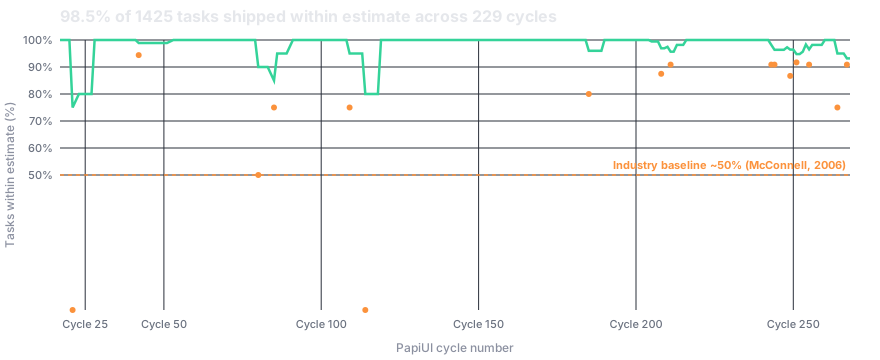
How it compares
McConnell's industry reference for software estimation puts unaided projects at roughly even odds of landing within estimate at all, with median schedule overruns of 30 to 50% (Software Estimation: Demystifying the Black Art, 2006). PAPI's 96.5% figure sits well above that baseline, sustained over more than two hundred cycles rather than a single project.
Methodology
Source: PapiUI's own build_reports table in Supabase. Each row is a completed build with the planner's estimated effort and the builder's reported actual effort.
- Cycle range: 0 to 378 inclusive (effort tracking began at cycle 17).
- Effort sizes map to points: XS=1, S=2, M=3, L=5, XL=8.
- “Within estimate” means actual_pts is at or below estimated_pts.
- Filter:
completed = 'Yes'. Cancelled, abandoned, or partially-completed builds are excluded. - Result: 2,968 of 3,076 = 96.5%.
What this means in practice
High estimation accuracy is not a claim that PAPI builds the right thing; it is a claim that when PAPI agrees to build something, the work lands inside the box the planner drew. Combined with structured handoffs and review cycles, that predictability is what lets a single builder coordinate a project of this size without the calendar slipping out from under them.